Toyota is making a bold move with its $3.6B Tacoma production shift, fundamentally changing how and where one of America’s most popular trucks is built. This strategic realignment highlights the growing importance of the Toyota Texas plant expansion and broader North American vehicle production trends in today’s evolving auto market.
As demand for trucks rises across the U.S., the automaker is adjusting its strategy to stay competitive, improve regional supply, and reduce risks tied to global logistics disruptions. The shift also reflects macroeconomic movements like the ongoing automotive reshoring trend and overall US truck production growth. For buyers, this transition could directly affect pricing, inventory availability, and delivery times in the near future.
In addition, this transition demonstrates how modern automakers are rethinking factory locations to stay closer to their primary consumer bases. It also underscores the critical need for flexible supply chains and faster distribution networks in modern manufacturing. As Toyota strengthens its U.S. production footprint, the move could serve as a blueprint for other companies planning similar regional strategies in the coming years.
Toyota’s $3.6B Tacoma Production Shift: What We Know So Far
The Toyota Tacoma production shift involves a massive $3.6 billion capital investment in Texas. This extensive upgrade focuses heavily on the San Antonio automotive manufacturing hub, where Tacoma trucks are now slated to be built in much larger numbers. The core objective is straightforward: to manufacture more vehicles closer to the American consumers purchasing them.
This operational shift introduces a major Tacoma assembly line reorganization. While production output is being scaled back at the Baja California Tacoma plant, assembly capacity is being ramped up significantly in Texas. This realignment improves manufacturing velocity and mitigates logistical delays within the Tacoma supply chain, directly helping the brand keep pace with surging domestic truck demand.
At the same time, this transition strengthens the overall Toyota truck manufacturing network across North America. By reallocating its production resources, Toyota can respond more dynamically to rapid market shifts and changing customer preferences. The move also lowers vehicle transportation costs and improves delivery timelines, making the entire distribution process far more efficient for both the company and its buyers.
Why Toyota Is Moving Tacoma Production From Mexico to Texas
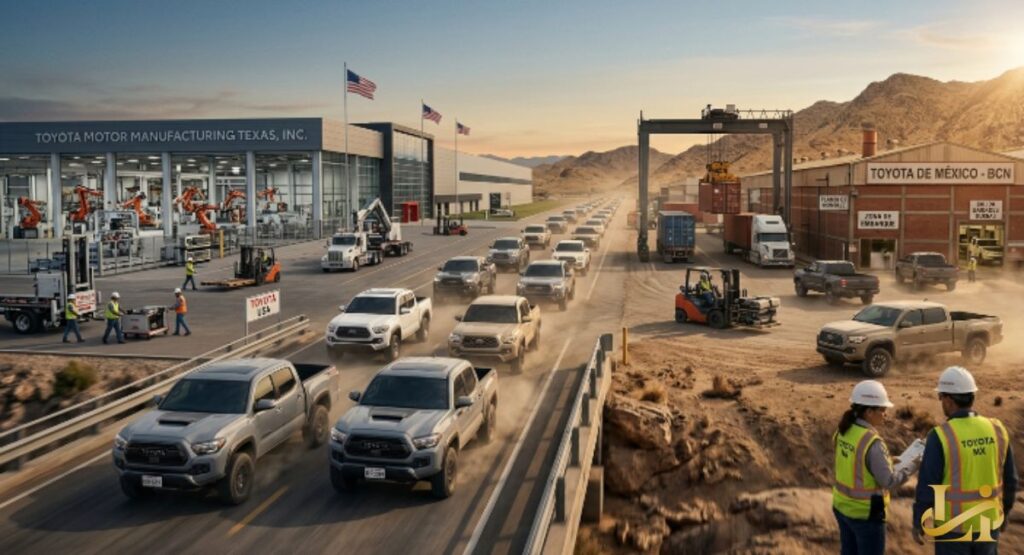
The Mexico facility pivots to other vehicle models and operations.
One key catalyst behind the Tacoma manufacturing relocation is overwhelming market demand. U.S. truck buyers expect faster delivery turnarounds and locally manufactured vehicles. The primary benefits of building trucks in the USA include significantly lower cross-border shipping costs and a more reliable localized supply.
Another major factor stems from trade policy. The overarching impact of the USMCA on the auto industry, combined with rising operational costs in Mexico, has pushed executive leadership to rethink its long-term strategy. This rebalancing reflects a broader US vs Mexico auto manufacturing shift and supports the ongoing reshoring of production across the US auto industry.
In addition, manufacturers are prioritizing long-term stability and operational resilience in volatile global markets. By bringing production closer to home, Toyota can better maintain strict quality control, manage localized labor costs, and avoid unexpected shipping delays. This proactive adjustment helps the brand maintain its competitive edge in a fast-changing automotive landscape.
What’s Included in the $3.6B San Antonio Expansion Plan
The Toyota Texas plant expansion focuses heavily on integrating advanced automation and achieving higher operational efficiency. The company is upgrading its factory systems to support a major plant capacity expansion and establish a much smoother production flow.
This project also serves as a major driver for regional job creation. The expansion significantly strengthens automotive manufacturing growth in Texas and provides a substantial economic boost to the local community.
It also introduces comprehensive training initiatives for the local workforce, driving skill development in advanced robotic manufacturing. As the factory footprint grows, it naturally attracts a denser network of component suppliers and related businesses to the region. This creates a robust industrial ecosystem that supports long-term economic stability across Texas.
| Feature | Before Expansion | After Expansion |
| Production Capacity | Moderate | High |
| Jobs | Limited | Increased |
| Technology | Standard | Advanced |
What Is Moving—and What’s Staying in Mexico
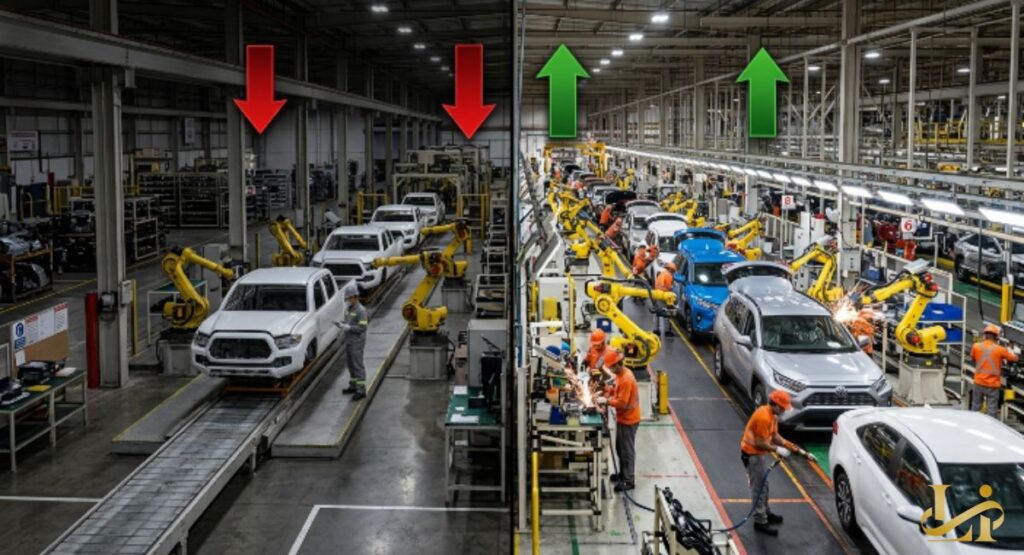
The split view clarifies the operational shift inside Mexico facilities.
Toyota is not fully relocating its entire manufacturing footprint. While the current Tacoma assembly line shift focuses primarily on Texas, critical components of its manufacturing operations will remain south of the border. The Guanajuato Toyota facility, for example, continues to produce other vehicles for the brand.
Meanwhile, the Baja California Tacoma plant is simply reducing its Tacoma vehicle output. This adjustment reflects a calculated production rebalancing rather than a total operational exit, allowing the company to maintain maximum manufacturing flexibility across its entire truck network.
This balanced approach allows the automaker to manage overhead costs effectively while still capitalizing on its established infrastructure in Mexico. It also minimizes regional risk by maintaining a diversified manufacturing footprint across North America. In the long term, this dual-regional strategy supports operational stability, cost efficiency, and smoother supply chain logistics to meet future market demand.
Why Toyota Is Not Fully Exiting Mexico Operations
While industry watchers may question whether Toyota is abandoning its Mexican production facilities entirely, the answer is a definitive no. Mexico continues to offer substantial cost advantages and a highly skilled automotive workforce, a balance that the automaker requires to remain globally competitive.
The localized Toyota Mexico production strategy remains an essential component of its broader global supply network. It supports a highly resilient manufacturing footprint and helps insulate the brand from the risks associated with wider automotive supply chain disruptions.
This dual-country manufacturing approach ensures that Toyota can pivot quickly in response to market volatility and shifting demand patterns. It also allows the organization to optimize production overhead without compromising on its stringent quality standards. By maintaining healthy operations in both regions, the company bolsters its resilience against future economic or logistical disruptions.
The Role of Trade Policy and Economic Uncertainty

Leadership analyzes compliance and economic data before relocating operations.
International trade regulations exert an enormous influence on the automotive sector. Evolving trade policy impacts have forced manufacturers to carefully re-evaluate where they choose to build their vehicles, and the regulatory framework of the USMCA has made domestic U.S. production increasingly attractive.
Broader economic volatility also plays a major role in these decisions. Rising material costs and unpredictable supply chains have forced automotive brands to adapt quickly, reflecting prominent automotive manufacturing trends shaping 2026 and driving long-term strategic planning.
These shifting conditions are encouraging automakers to prioritize regionalized production and reduce their systemic dependence on fragile, distant supply chains. It also underscores just how critical flexibility has become to modern industrial engineering. As global trade policies and economic climates continue to shift, manufacturers must remain agile to preserve their market efficiency and long-term competitiveness.
Why the Baja Plant Was Due for a Major Change
The Baja California Tacoma plant had run into structural bottlenecks in recent years. Aging factory infrastructure and climbing regional operational costs had steadily diminished its overall efficiency, serving as primary catalysts for the strategic adjustments at the facility.
The company required a modernized operational framework. Transferring a portion of its production capacity allows for comprehensive system modernization and better factory throughput, aligning the facility with long-term goals for the future of Tacoma manufacturing.
This transition allows the automaker to invest heavily in next-generation manufacturing tech and smarter, automated assembly systems. It also sharpens overall quality control metrics while curbing long-term operational overhead. Looking at the bigger picture, this pivot successfully positions the brand to remain a dominant force in a rapidly changing automotive market.
Key Goals Behind Toyota’s Tacoma Production Relocation
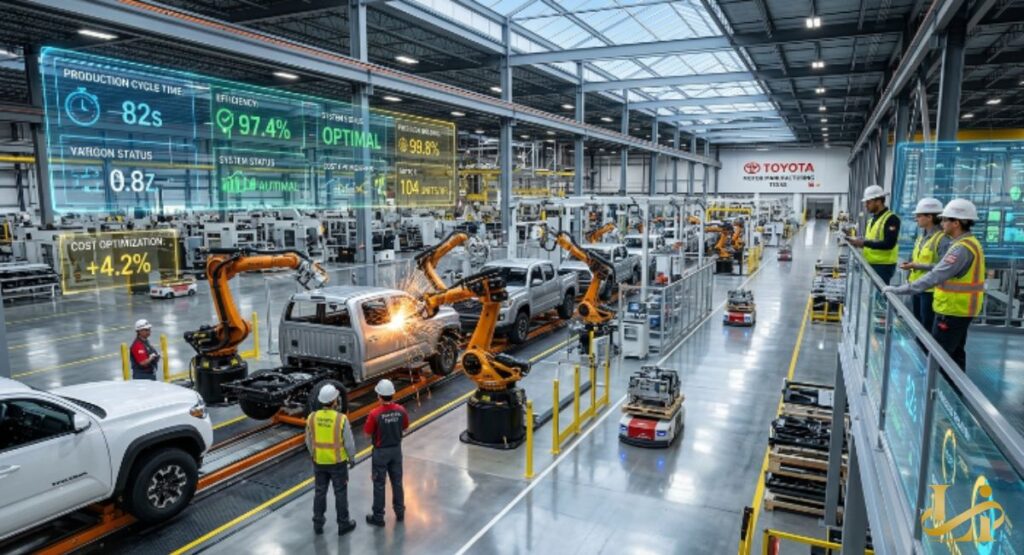
Digital dashboards track 97.4% efficiency and 4.2% cost gains in real time.
The primary motivation driving the Tacoma manufacturing relocation centers on maximizing operational efficiency. The brand wants to secure faster delivery windows and tighter cost controls, both of which directly enhance the end-customer experience.
Long-term market growth is another central objective. The company is directly addressing current truck demand forecasts and capitalizing on sustained consumer interest in midsize utility vehicles, strengthening domestic midsize truck production capabilities for the future.
In addition, this strategy gives the brand the agility needed to thrive in a highly competitive segment. It enables a much faster corporate response to shifting buyer preferences and emerging design trends. Over time, this structural layout will support ongoing innovation in truck design, powertrain performance, and factory floor efficiency.
What This Means for Tacoma Buyers and Pricing
Retail consumers will notice several practical changes as these updates take effect. The localized relocation will deliver faster vehicle transport times and improved dealership availability, with the overall stability of the Tacoma supply chain expected to rise.
Vehicle pricing may experience minor adjustments. Shifting to domestic assembly slashes expensive overseas freight fees, though U.S. labor costs are inherently higher. Even so, buyers will ultimately benefit from the predictable quality and build standards expected of a modern U.S. manufacturing facility.
In the long run, buyers can look forward to highly consistent vehicle build quality and significantly shorter factory-to-delivery waiting periods. Dealership inventory levels should also become far more stable, making it much easier for consumers to locate specific trim levels and options pack configurations. This overall operational pivot significantly upgrades the dealership purchasing experience and reinforces consumer trust in the vehicle lineup.
| Factor | Impact on Buyers |
| Delivery Time | Faster |
| Availability | Improved |
| Price | Slight variation |
Why This Move Matters Beyond the Automotive Industry

Texas becomes a central node for automotive and freight infrastructure.
This industrial pivot carries implications that extend far beyond the truck segment alone. It serves as a prominent example of the broader industrial reshoring trend and represents a fundamental shift in how global corporations map out their long-term logistics. Multiple sectors are currently adopting very similar localized manufacturing models.
The capital allocation also highlights the scale of the brand’s current North American investment strategy. It showcases how multinational companies adapt to regulatory pressure while actively pouring resources into local economies, serving as a cornerstone of the evolving North American vehicle manufacturing ecosystem.
Furthermore, it signals a structural shift toward regionalized manufacturing hubs where production facilities are strategically built close to their primary retail markets. This localized philosophy drastically reduces a company’s exposure to international logistical shocks and builds deeper supply chain resilience. As more industrial manufacturers follow this trajectory, it could fundamentally redefine how consumer goods are produced and distributed across North America.
Final Thoughts on Toyota’s $3.6B Tacoma Production Shift
The $3.6B Tacoma production shift is far more than a routine reallocation of factory assets. It is a calculated, long-term business decision shaped by consumer demand, international trade policies, and future market growth, modernizing the entire assembly pipeline into a faster, smarter system.
Looking forward, the production outlook for the midsize truck platform appears remarkably secure. Armed with localized manufacturing systems and a highly optimized supply chain, the automaker is exceptionally well-positioned to maintain its historical dominance in the competitive U.S. truck market.
This operational transition also sharpens the organization’s ability to pivot alongside evolving consumer needs and macroeconomic shifts. By focusing heavily on manufacturing innovation and structural efficiency, the company is building a highly resilient production template. In the long term, this overarching strategy ensures sustained financial growth while reinforcing its core competitive edge in the midsize truck category.
FAQS
Is Toyota moving out of Mexico to the US?
No, Toyota is not abandoning its operations in Mexico; the company is simply optimizing its regional production split to better balance manufacturing costs with distribution efficiency.
Is Toyota moving Tacoma production to Texas?
Yes, Toyota is shifting a significant portion of Tacoma assembly operations to its Texas facility to maximize regional logistics efficiency and meet high domestic market demand.
Which state sells the most Toyota Tacomas?
California consistently leads the nation in total Toyota Tacoma sales volume due to the region’s massive, sustained consumer demand for versatile midsize trucks.
Where is the Toyota Tacoma produced?
The Toyota Tacoma is primarily manufactured at the brand’s advanced assembly facility in Texas, USA, with a portion of auxiliary production remaining supported by its facilities in Mexico.
Is there any vehicle 100% made in America?
No, modern automotive supply chains rely on a highly complex network of global components, meaning no mass-produced consumer vehicle is sourced and assembled entirely within the United States.

I write about the world of luxury, from timeless style to premium living, inspiring readers to embrace elegance in everyday life.